
ANCIP Webinar Series
-
ANCIP Webinar 1
African Union Responses to Unconstitutional Changes of Government: Current Challenges and Lessons Learned
-
ANCIP Webinar 2
ECOWAS at 50: Reflections on Legitimacy, Intervention, and Regional Order
-
ANCIP Webinar 3
Implementing the Women, Peace and Security agenda at and with the African Union: Insights from the AU Panel of the Wise
-
ANCIP Webinar 4
Building Infrastructures for Peace – Insights from West Africa
-
ANCIP Webinar 5
Civil Society Inclusion in African Regional Interventions: AU and ECOWAS with the People?
African Union Responses to Unconstitutional Changes of Government: Current Challenges and Lessons Learned
© 2025 ANCIP Project. All rights reserved. (Chrome browser recommended for playback)
Panel Content
Between April 2019 and August 2023, Africa experienced ten unconstitutional seizures of power, along with several failed attempts of a coup d’état. Previously, coups had become rare, and the African Union (AU), together with the Regional Economic Communities (RECs), enforced relatively short transitions by leveraging robust frameworks — notably the 1999 Lomé Declaration and the 2007 African Charter on Democracy, Elections and Governance. This trend has now shifted. Coups are more frequent, transitions more protracted, and the rule barring perpetrators of unconstitutional changes of government (UCGs) from contesting elections meant to restore constitutional order is increasingly disregarded. The credibility of international actors has been weakened by their failure to address underlying governance issues, while inconsistent application of AU and RECs norms has eroded deterrence.
The Webinar discussion will centre on the newly published ANCIP Working Paper by El-Ghassim Wane on “The African Union and Coups: Why Implementation Matters More than New Norms”. Amid calls to revise existing frameworks, participants of this webinar discuss what exactly the current challenges for the AU and the RECs are, and what lessons can be learned from past responses to UCGs.
Panelists
Amb. Said Djinnit has been Special Envoy of the UN Secretary-General for the Great Lakes region (2014–2019). Previously he has served as the UN Special Representative and Head of the UN Office for West Africa (UNOWA, 2008–2014), and as the AU’s first Commissioner for Peace and Security (2003–2008).
El-Ghassim Wane is the former UN Secretary-General’s Special Representative for Mali and former Head of the UN Multidimensional Integrated Stabilization Mission in Mali (MINUSMA, 2021–2024). Previously he has served as Chief of Staff and Chief Adviser of the AU Commission chairperson (2017–2019), UN Assistant Secretary-General for Peacekeeping Operations (2016–2017) as well as AU Commission Peace and Security Director and Head of the Conflict Management Division.
Antonia Witt is Head of the Research Group ‘African Intervention Politics’ at the Peace Research Institute Frankfurt (PRIF). Her research focuses on African regional interventions in response to coups and political crises, including local perspectives and expectations. She is the author of Undoing Coups: The African Union and Post-Coup Intervention in Madagascar (2020, ZedBooks).
Moderator:
Ulf Engel is Professor of ‘Politics in Africa’ at the Institute of African Studies, Leipzig University. He is also a visiting professor at the Institute for Peace and Security Studies at Addis Ababa University (Ethiopia) and a professor extraordinary at the Department of Political Science at Stellenbosch University (South Africa).
ANCIP Webinar 1
Date
10 July 2025 at 9AM (GMT)
Location
Zoom
Panelists
Amb. Said Djinnit, El-Ghassim Wane, Antonia Witt
ECOWAS at 50: Reflections on Legitimacy, Intervention, and Regional Order

Panel Content
As ECOWAS marks its 50th anniversary, the regional organization stands at a critical juncture. Once regarded as a central actor in regional integration and crisis response in West Africa, ECOWAS is now navigating a rapidly evolving political and institutional landscape. The withdrawal of the Alliance of Sahel States (AES), growing critiques of its governance frameworks, and the shifting nature of its external partnerships have prompted renewed reflection on its legitimacy, relevance, and future direction.
This webinar – in co-organization with the Kofi Annan International Peacekeeping Training Centre (KAIPTC) – brings together a panel of experts and practitioners to reflect on the challenges and opportunities facing ECOWAS today. Against the backdrop of recent political upheavals and broader debates over regional security and governance, the discussion will explore ECOWAS’s evolving institutional practices, its normative commitments, and its financial and operational capacities. It will also consider the changing dynamics of international support and cooperation, particularly in light of ECOWAS’s long-standing relationship with the European Union. At a moment of both uncertainty and possibility, this conversation seeks to generate critical insights into how ECOWAS can adapt and respond to the demands of a shifting regional order. We will in particular ask how non-military aspects of ECOWAS interventions can be better understood and further strengthened.
Panelists
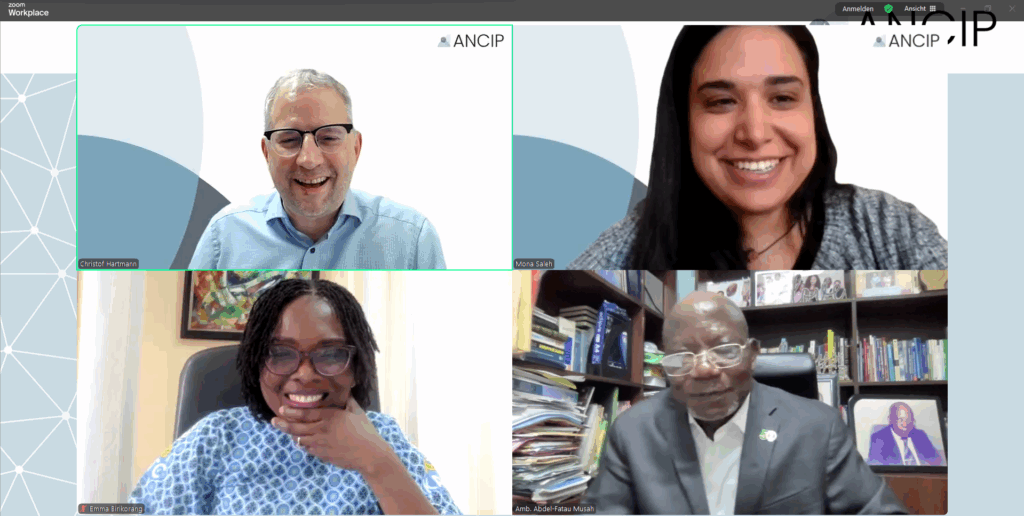
Amb. Abdel-Fatau Musah – Commissioner for Political Affairs, Peace and Security at the ECOWAS Commission.
Emma Birikorang – Director of Research of the Kofi Annan International Peacekeeping Training Centre (KAIPTC).
Mona Saleh – Research Fellow at the Institute for Development and Peace (INEF), Duisburg-Essen University.
Moderator:
Christof Hartmann – Director of the Institute for Development and Peace (INEF), University of Duisburg-Essen.
Panel Summary
On 18 July 2025, the ANCIP research network, in cooperation with the Kofi Annan International Peacekeeping Training Centre (KAIPTC) in Accra, hosted a timely webinar exploring the evolving challenges facing ECOWAS. The webinar offered an opportunity to critically assess ECOWAS’s achievements and the increasingly complex political and security challenges it faces, especially as the organisation marks its 50th anniversary. The panel featured H.E. Ambassador Abdel-Fatau Musah, ECOWAS Commissioner for Political Affairs, Peace and Security; KAIPTC Director of Research Emma Birikorang; and INEF Postdoctoral Fellow Mona Saleh, and was chaired by INEF Director Christof Hartmann.
A first key theme that emerged from the discussion concerned ECOWAS’s recent interventions, particularly in Mali, Burkina Faso, and Niger, and why they have failed to reverse military takeovers or restore constitutional rule. Ambassador Musah pointed to a profound shift in the regional and international political landscape. Until 2020, ECOWAS operated in a relatively cohesive international context that broadly supported democratic norms. In contrast, today’s world order, marked by the rising influence and multiplicity of actors, has diminished ECOWAS’s leverage by providing alternative sources of political and material support to military regimes, thereby weakening sanctions and mediation efforts.
Ambassador Musah also noted that ECOWAS had previously agreed on transition timelines with Mali and Burkina Faso, due by the end of 2024. However, sanctions imposed outside the organisation’s regular procedures strained relations with the transitional authorities and eventually culminated in their withdrawal from ECOWAS. This outcome signals both the fragmentation of regional solidarity and ECOWAS’s limited capacity to adapt its responses to a changing geopolitical environment shaped by digital disinformation, youth discontent, and rising global competition. Musah warned that although some military regimes present themselves as aligned with popular sentiment, this does not guarantee effective governance, raising a critical question: how can democracy be legitimised by delegitimising coups?
The webinar also addressed internal dynamics within ECOWAS. Emma Birikorang highlighted that a lack of consensus among heads of state has weakened the authority of the Commission and complicated diplomatic efforts. She stressed that ECOWAS suffers from increasingly divided leadership, making it difficult for the organisation to define a unified strategic direction. Birikorang underscored the weakening of ECOWAS’s mediation capacity and pointed to the absence of strong regional leaders as champions who, in the past, had upheld democratic norms and helped drive political consensus. In the past, figures like Presidents Obasanjo and Kufuor played such roles, lending political weight to ECOWAS decisions. Today, such figures are missing, leaving the organisation without the high-level champions it once relied on. This fragmentation within the Authority of Heads of State has made mediation more difficult and contributed to the organisation’s slow and reactive posture.
Birikorang also emphasised that much of ECOWAS’s conflict prevention and mediation work takes place quietly, making it less visible to the public. She noted that ECOWAS has traditionally preferred discreet diplomacy, especially in its non-military interventions such as mediation and early warning, which often go unacknowledged. For instance, she referred to ECOWAS’s continuous engagement in Sierra Leone following contested elections, which helped stabilise the country and prevent a descent into conflict.
In terms of external partnerships, the panel agreed that ECOWAS must diversify its alliances without compromising its principles. Mona Saleh noted that while traditional donors like the EU remain central particularly in supporting non-military interventions such as mediation, early warning, and peacebuilding; ECOWAS must assert and communicate its own strategic priorities more clearly for mutually beneficial partnerships. The entry of new actors like China, Russia, Turkey, and several Gulf states represents both a challenge and an opportunity. Saleh argued that ECOWAS should leverage these emerging relationships to promote its own peace and security agenda rather than respond to the interests of external partners. She cautioned, however, that these new actors often operate through bilateral agreements and pursue different political and economic models than those promoted by the EU, a context which makes it essential for ECOWAS to develop its own coherent strategies for engaging with external partners.
© 2025 ANCIP Project. All rights reserved.
Saleh also pointed out that some tensions between ECOWAS and traditional partners have emerged due to shifting donor priorities. The EU, for instance, has started to more explicitly link aid to its own political and strategic interests, which may not always align with ECOWAS’s goals. Nevertheless, she stressed that this changing context also provides ECOWAS with an opportunity to strengthen its autonomy and articulate clearer positions in its external engagements.
Looking ahead, Ambassador Musah outlined ECOWAS’s broader strategic vision, which includes strengthening non-military tools, increasing youth engagement, and reviving civil society participation through mechanisms such as the establishment of the ECOWAS Economic and Social Council Commission (ECOSOC). He also highlighted efforts to expand cooperation on counterterrorism and violent extremism, including with countries currently outside the organisation.
The webinar concluded with a strong call for more proactive and transparent communication from ECOWAS. Participants noted that while its achievements in early warning, mediation, and post-conflict engagement often remain unnoticed, its shortcomings are highly visible. Improving public outreach and civil society engagement is therefore critical to restoring ECOWAS’s legitimacy and ensuring the sustainability of its regional integration and peacebuilding agenda.
For additional info please refer to the ANCIP policy briefs written by Emma Birikorang and Mona Saleh.
ANCIP Webinar 2
Date
18 July 2025 at 10AM (GMT) / (11AM Abuja, 1PM Addis Ababa, 12AM Berlin)
Location
Zoom
Panelists
Abdel-Fatau Musah, Emma Birikorang, Mona Saleh
Implemeting the Women, Peace and Security agenda at and with the African Union: Insights from the AU Panel of the Wise
© 2025 ANCIP Project. All rights reserved. (Chrome browser recommended for playback)
Panel Content
The 25th anniversary of the United Nation Security Council Resolution 1325 (2000) presents an opportunity to celebrate the progress made in the field of Women, Peace and Security (WPS), while critically assessing the road ahead. The African Union has pledged to work towards gender equality since its establishment in 2001, drafting policies and frameworks, upholding gender equality quota at its Commisson and creating directorates and programmes. This webinar is dedicated to the practices of the AU Panel of the Wise, one of the five pillars of the African Peace and Security Architecture (APSA), which represents an actor working towards gender equality, while not devoted solely to gender issues.
Conceptualized and established as a continental conflict prevention mechanism, the five-member institution is shaping and implementing feminist policies amongst other peace and security operations. Panel members and their team at the AU Department of Political Affairs, Peace and Security (AU PAPS) have established norms as well as institutions at the African Union. Their report on women and children in armed conflicts (2014) and their subsidary mechanism, the AU Network of African Women in Conflict Prevention and Mediation (FemWise-Africa) have shaped continental WPS policies, promoting the political inclusion, empowerment and protection of women and their rights.
What can we learn from the actions of the AU Panel of the Wise and its strategies to mainstream gender? How are panel members and representatives of their subsidiary mechanims implementing the AU WPS agenda? Do the initiatives and policies of the African Union trickle down to local politics? Can local policy-makers learn from AU initiatives and what should AU policy makers learn from local actors? These are some of the questions addressed in this ANCIP Webinar.
For additional information please refer to the ANCIP policy brief written by Camille Vern.
Panelists
Lady Justice Effie Owuor is a member of the AU Panel of the Wise and the co-chair of FemWise-Africa since 2022. She was the first Kenyan female state council in 1967 and the country’s first woman serving as a high court judge. She founded the Kenya Women Judges Association, promoting the equitable and meaningful participation of women in the justice sector.
Varaidzo Carol Mupunga is a former member of FemWise-Africa. In this capacity, she has served as a Mediation and Advocacy Officer at the African Union Mission in Juba, South Sudan. She is an alumna of the African Leadership Centre (ALC) Women, Leadership Peace and Security Fellowship.
Karmen Tornius is a postdoctoral researcher at the Danish Institute for International Studies (DIIS). She is an expert on the AU gender equality initiatives, Women, Peace and Security (WPS) agenda, pan-African feminist organizations and networks, as well as gender policies in Kenya and Ethiopia.
Camille Vern is a research fellow at Leipzig University and part of the research network African Non-Military Conflict Intervention Practices (ANCIP). Her research focuses on the practices of the AU Panel of the Wise. She is a trained mediator and has specialized on the implementation of the WPS agenda.
Moderator:
Ulf Engel is Professor of ‘Politics in Africa’ at the Institute of African Studies, Leipzig University. He is also a visiting professor at the Institute for Peace and Security Studies at Addis Ababa University (Ethiopia) and a professor extraordinary at the Department of Political Science at Stellenbosch University (South Africa).
ANCIP Webinar 3
Date
13 November 2025 at 12h GMT / 15h in Nairobi / 13h in Berlin
Location
Zoom
Panelists
Lady Justice Effie Owuor
Varaidzo Carol Mupunga
Karmen Tornius
Camille Vern
Building Infrastructures for Peace – Insights from West Africa
© 2025 ANCIP Project. All rights reserved. (Chrome browser recommended for playback)
Panel Content
The webinar “Building Infrastructures for Peace – Insights from West Africa” examines the development of networked peacebuilding through Infrastructures for Peace (I4P) on the African continent. Central to the discussion is how different stakeholders — including civil society, traditional and religious leaders, and public officials — can create synergies between their approaches to peacebuilding. Together with our panelists, the session will explore African peace architectures, with a particular focus on West Africa, to assess both the potential and the challenges of I4P.
When I4P first entered the peacebuilding discourse, it was emphasized that such structures should remain creative and adaptable to survive shifts in conflict dynamics. This is especially relevant for West Africa, where the nature of conflict is evolving. The panel will invite the participants to reflect on the structural aspects and frame conditions of regional early warning, conflict prevention and conflict transformation. Particular attention will be given to the role of actors such as ECOWAS and the United Nations in developing and sustaining I4P. By doing so, the webinar contributes to the growing discourse on I4P in West Africa and beyond, while offering expert insights into the regional peacebuilding landscape and prospects for the future.
For additional information please refer to the ANCIP policy brief written by Jasmin Schmitz.
Panelists
Clever Nyathi is a senior conflict prevention advisor with UNDP and the UN Resident Coordinator’s Office (RCO) in Malawi. He has supported peace processes in Sierra Leone, Ghana, Zimbabwe, and Lesotho as part of UNDP. He has garnered expertise in the prevention of electoral violence, and he holds a PhD from the University of Saskatchewan, Canada.
Edwige Dede Mensah is the WANEP Liaison Officer at the ECOWAS Commission. As part of her office, she upholds a close link with ECOWAS’ Early Warning Department in the organization of the early warning system, ECOWARN.
Mir Mubashir is a senior advisor on dialogue and mediation support with the Berhof Foundation.
Jasmin Schmitz is a research fellow at the Institute for Development and Peace at the University of Duisburg-Essen and a member of the research network African Non-Military Conflict Intervention Practices (ANCIP). In her research, she focuses on Infrastructures for Peace (i4p) in various contexts, as well as reconstructing the role of local peace committees.
Moderator:
Christof Hartmann is Director of the Institute for Development and Peace (INEF), University of Duisburg-Essen.
ANCIP Webinar 4
Date
19 November 2025 at 10h GMT /
11h CET / 12h CAT
Location
Zoom
Panelists
Clever Nyathi
Edwige Dede Mensah
Mire Mubashir
Jasmin Schmitz
Civil Society Inclusion in African Regional Interventions: AU and ECOWAS with the People? / Inclusion de la société civile dans les interventions régionales africaines : l'UA et la CEDEAO avec les peuples ?
© 2025 ANCIP Project. All rights reserved (Chrome browser recommended for playback)
Panel Content
(french version below)
In their visions and policy frameworks, African regional organizations—most notably the African Union (AU) and the Economic Community of West African States (ECOWAS)—explicitly recognize their citizens and civil societies as central actors in promoting peace and prosperity. Yet, how are these commitments translated into practice?
This webinar brings together perspectives from academia and civil society to examine how civil society actors are actually included (or excluded) in conflict interventions of these two organizations. Insights from case studies in Mali and Guinea will help illuminate recurring patterns observed in the practical implementation of regional conflict interventions. The panel will highlight the importance of meaningful civil society inclusion, explore practical challenges, and discuss strategies to strengthen civil society inclusion in African regional interventions.
See also the recent ANCIP working paper by Jonas Schaaf.
Simultaneous interpretation in English and French will be provided for the webinar.
Une interprétation simultanée en anglais et en français sera disponible pendant le webinaire.
Panelists
Fatou Jagne Senghore
Jurist and Human Rights Advocate, Founder of the Center for Women’s Rights and Leadership, Banjul
Jonathan Sandy
Founder and Executive Director of the Regional Center for Governance and Security Policy Initiative in Freetown; former Chairperson of the AU ECOSOCC Peace and Security Cluster
Lamine Savané
Lecturer and Researcher at the Faculty of Social Sciences (FASSO) of the University of Ségou, Associated Researcher at Peace Research Institute Frankfurt (PRIF)
Jonas Schaaf
Researcher at the Peace Research Institute Frankfurt (PRIF)
Moderator:
Antonia Witt
Head of Research Group “African Intervention Politics” at the Peace Research Institute Frankfurt (PRIF)
Contenu du Webinaire
Dans leurs visions et cadres politique, les organisations régionales africaines, notamment l’Union africaine (UA) et la Communauté économique des États de l’Afrique de l’Ouest (CEDEAO), reconnaissent explicitement leurs citoyens et les organisations de la société civile en tant qu’acteurs centraux dans la promotion de la paix et de la prospérité. Pourtant, comment ces engagements se traduisent-ils concrètement sur le terrain ?
Ce webinaire réunit des perspectives provenant à la fois du milieu académique et de la société civile pour examiner la manière dont les acteurs de la société civile sont réellement inclus (ou exclus) dans les interventions de conflit menées par ces deux organisations. Les enseignements tirés des études de cas au Mali et en Guinée serviront à identifier les schémas récurrents observés dans la mise en œuvre pratique des interventions régionales. Le panel soulignera l’importance de l’inclusion significative de la société civile, examinera les obstacles pratiques et discutera des stratégies visant à renforcer l’inclusion de la société civile dans les interventions régionales Africaines.
Cet événement fait partie de la série de webinaires ANCIP, qui réunit des voix d’experts du monde académique et du terrain. Depuis 2022, le projet African Non-Military Conflict Intervention Practices vise à relier la recherche innovante au dialogue politique. Le webinaire offre une plateforme clé pour partager les résultats avec des experts tout en atteignant un public plus large.